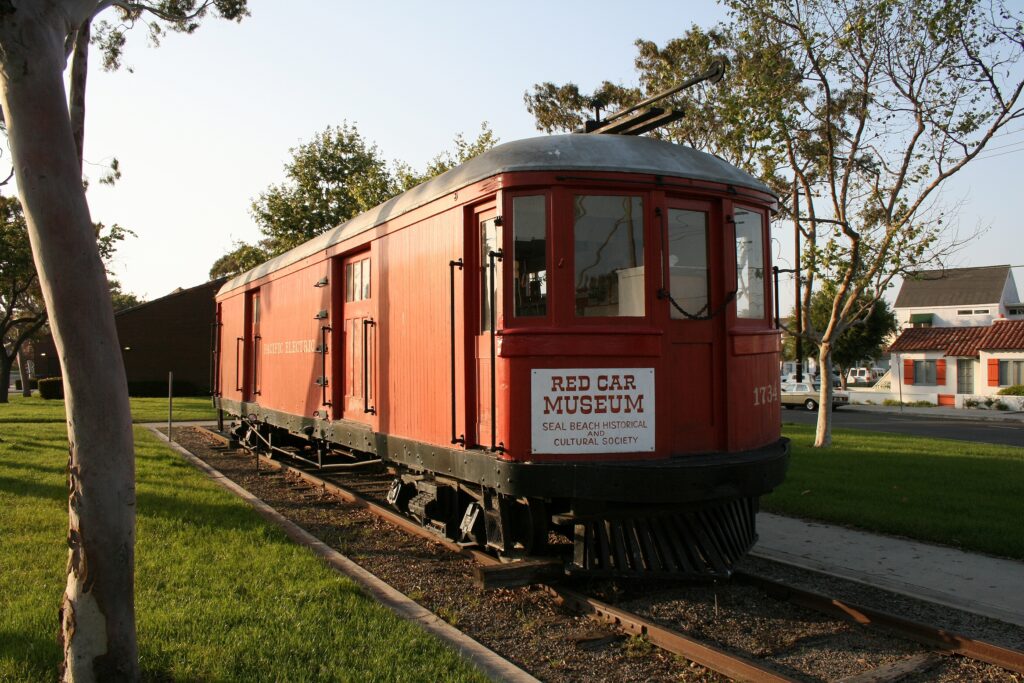
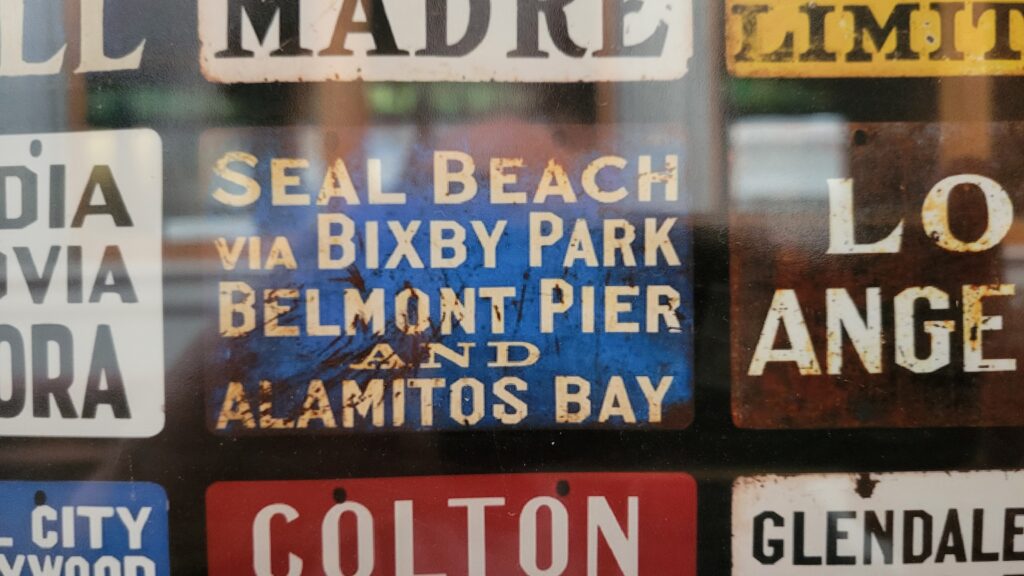
The Pacific Electric Railway was once the largest interurban railway system in the world, with over 1,000 miles of track linking cities across Southern California — from the San Fernando Valley to San Bernadino. The Newport-Balboa line, which ran from North Long Beach, to Newport Beach, reached Seal Beach (then Bay City) and Anaheim Landing in late May 1904. Car 1734, the Red Car owned by the Seal Beach Historic Resources Foundation, is a Tower Car, one of 26 rolling repair shops used by the PE over its 55 year history to maintain, re-grease, and repair the overhead 600-watt electric lines that powered the Red Cars.
Car 1734 had a platform on top that could be raised up to allow repairman to repair and replace the overhead wires carrying the 6,000 watts of electrical current that kept the Red Cars rolling. It was a rolling repair shop, usually containing a crew of four, that maintained the lines that kept the Red Car moving.

Built in 1925 at the PE’s Torrance Shop, Car 1734, spent 25 years of service, but it actually operated as 1734 for only six years, converting to 00161 in the PE’s 1931 reorganization and renumbering. 1734 primarily maintained the lines of the Southern District which included the harbor, Long Beach and the 40-mile long Newport-Balboa line which ran from Willow Station in Long Beach to Newport Beach.
When the Pacific Electric ended passenger service on the Balboa line in 1950, Car 1734 was taken off line, and cannibalized for parts until 1961 when it was consigned to a scrap yard on Terminal Island.
When their plans to acquire a local house for a museum fell through, the Seal Beach Historical and Cultural Society decided to use local donations and one of the first Federal bicentennial commission grants, to acquire Car 1734 in Dec 1972 for $750. North American Rockwell (now Boeing) provided a flatbed truck to transport the car from San Pedro to Seal Beach where it was first at First and Marina and then on the old PE right of way near 14th Street.
The car, basically a windowless derelict at the time, was painstakingly restored over the next seven years. After the city decided to convert the old PE right-of-way to a greenbelt, the car was set in place in on rails provided by the Navy Weapons Station. The first coats of red paint were applied by local boy and girl scouts, the platform and stairs supplied by woodshop classes at Long Beach State, and the rails were provided by the Naval Weapons Station.
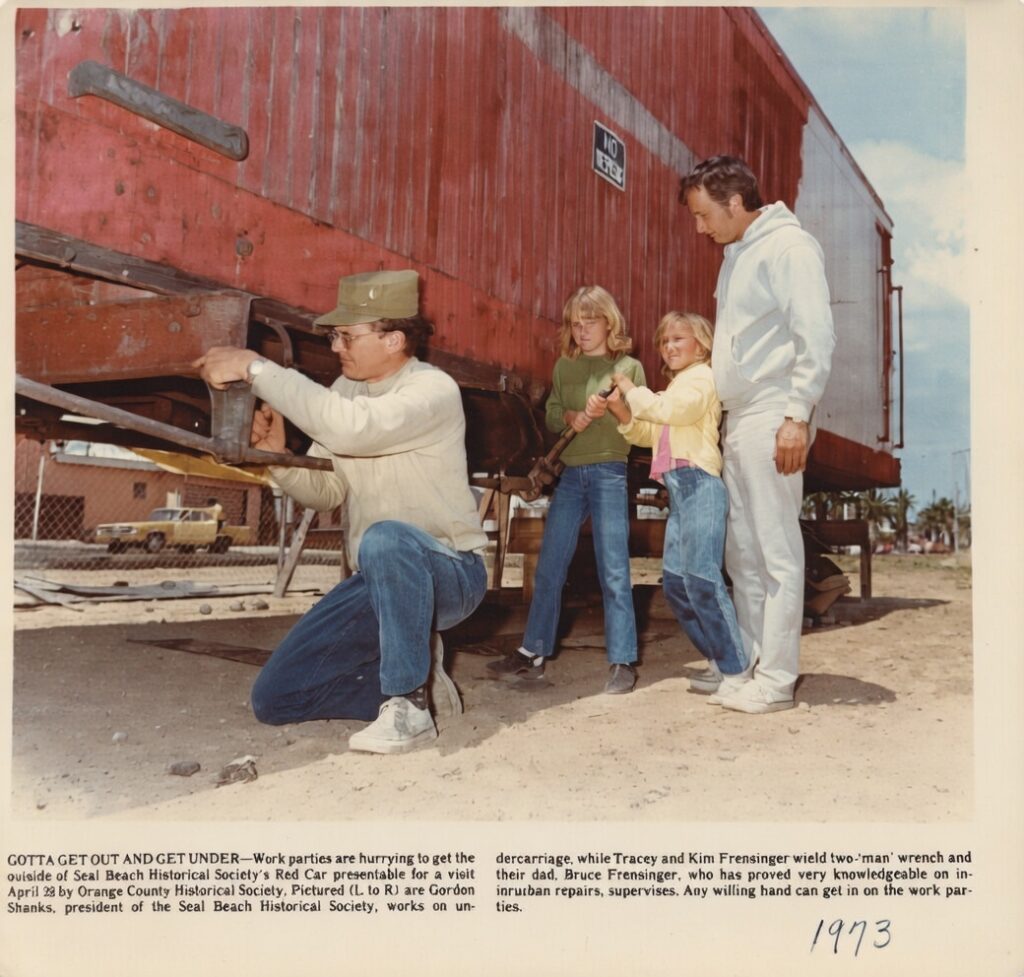
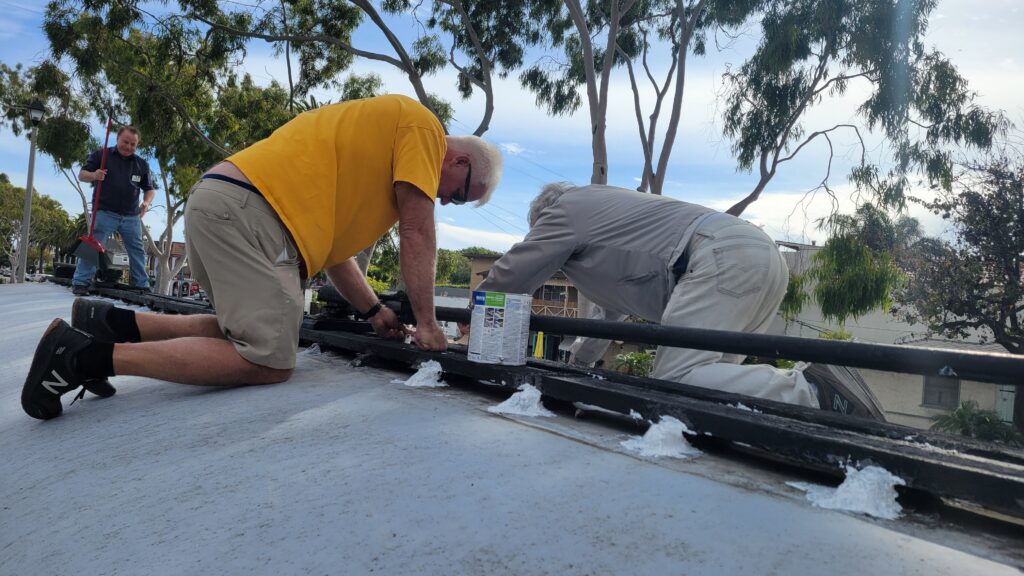
The Red Car Museum finally formally opened in late 1980. It was closed for renovation in the late 1990s and again when the Society went bankrupt during Covid. It was purchased by the Seal Beach Lions and transferred to the newly formed Seal Beach Historic Resources Foundation in 2023 which is currently working with the Lions to make some needed repairs to get it reopened.
The new Foundation has worked with Long Beach State design students to get possible ideas for the site. But a more immediate issue is to deal with the rotting wood, termite damage and leaky sides that